Featured in our calendar “2027 North Carolina Through the Years” for July
There was a time when a Sunday in North Carolina felt comparatively quiet, until pro sports in North Carolina came to town.
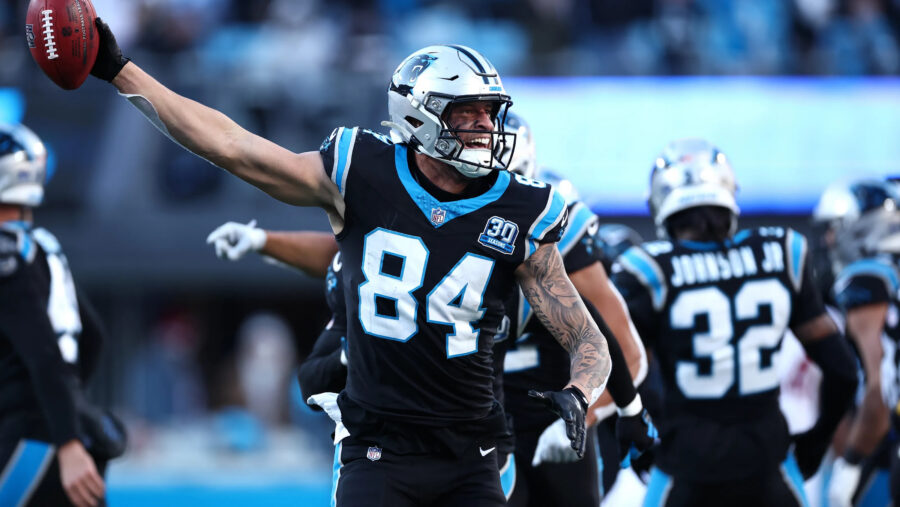
Saturdays belonged to college football and basketball rivalries, but once the weekend turned, the energy dipped. That rhythm changed in 1995, when the Carolina Panthers took the field for the first time and gave the region something it had never fully possessed before: a shared, statewide professional identity.
To understand how significant that shift was, it helps to go back even earlier, to 1988, when the Charlotte Hornets arrived. Their teal jerseys and fast-paced style made them instantly recognizable, but the deeper impact was cultural. Charlotte wasn’t just a banking hub anymore. It was a sports city. Attendance numbers surged. Merchandise traveled.
The idea that North Carolina could support major league franchises stopped being theoretical.
Still, basketball alone didn’t unify the state. It complemented what was already there—deep-rooted college loyalty—but it didn’t replace it. The Panthers changed that equation.
Branded as “Carolina,” not just “Charlotte,” the team invited fans from both North and South Carolina into a single orbit. That distinction mattered. It widened emotional ownership. Suddenly, living in Winston-Salem or Greensboro didn’t make you peripheral. You were part of the core audience.
Hockey’s arrival was less certain. When the Hartford Whalers-turned-Carolina Hurricanes relocated to North Carolina in 1997, skepticism followed. Ice hockey in the South felt mismatched. Early attendance reflected that hesitation. But sports cultures rarely emerge fully formed; they are built through exposure, repetition, and eventually success. By the time the Hurricanes captured the Stanley Cup in 2006, the narrative had shifted. Hockey was no longer an outsider—it had earned its place.
More recently, Charlotte FC has introduced yet another dimension. Soccer’s growth in the United States has been gradual but undeniable, and North Carolina—already strong at the collegiate level—proved ready for a professional club. The inaugural matches weren’t tentative affairs; they were loud, crowded, and immediate signals that the state’s sports appetite continues to expand.
What’s striking is not just the presence of these teams, but the way they coexist. North Carolina did not abandon its college traditions to make room for professional sports. Instead, it layered them. Saturdays still carry the weight of Tobacco Road rivalries. Sundays now belong to the NFL. Weeknights fill with NBA and NHL schedules. The calendar, once narrow, has become continuous.
That layering has consequences beyond entertainment. It reshapes how communities gather, how cities invest, and how identity forms over time. Professional sports create shared reference points. They give people something to follow collectively, something that unfolds over months and years rather than single afternoons.
There’s a practical logic underneath all of it. Teams that endure are not built on single seasons. They rely on infrastructure—front offices, scouting systems, development pipelines. Success is cumulative, not accidental.
Find Your Voice for Medicare & Insurance Guidance
That same principle applies in less visible areas of life, particularly in how people approach healthcare as they age. The transition into Medicare is rarely straightforward. It involves choices that interact with one another over time, often in ways that are not immediately obvious.
Blue Moon Benefits Group works within that complexity. Based in Clemmons and High Point, we operate independently, which allows us to evaluate plans without being tied to a single provider. Our role is not to rush decisions but to build understanding, helping individuals see how today’s selection affects tomorrow’s stability.