Featured in our calendar “2027 North Carolina Through the Years” for October
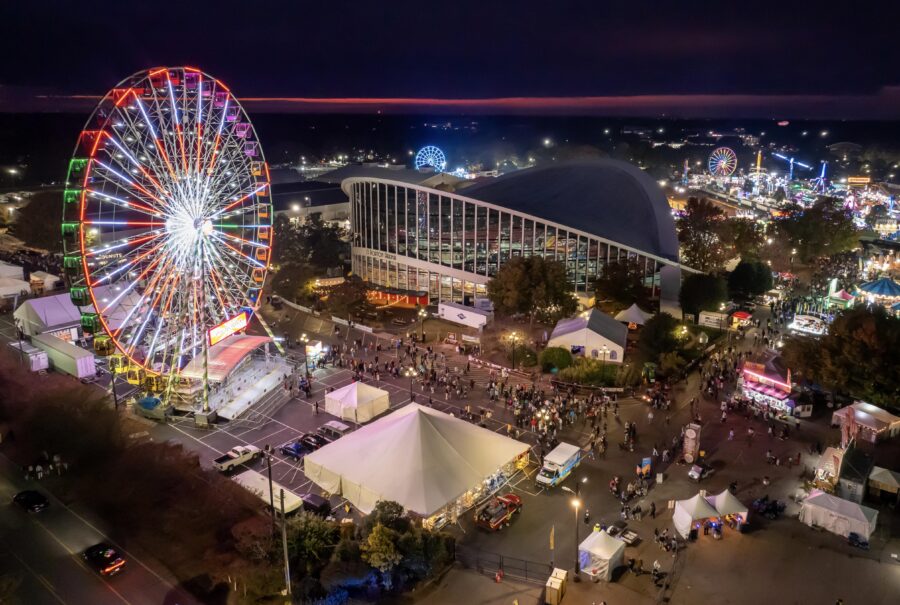
Every October, Raleigh becomes something slightly different: the pace shifts, the traffic changes, and the North Carolina State Fair reappears. It’s time for fall again!
When the fair first opened in 1853, it was not designed to entertain in the modern sense. It was practical. Farmers brought livestock. Craftsmen displayed tools. The purpose was exchange—of ideas, techniques, and standards. It was a place where progress could be measured in visible terms.
Over time, the fair absorbed new elements. Industrialization introduced machinery. Urbanization brought new audiences. Food, rides, and performances expanded its appeal. Yet the original structure never fully disappeared. Agriculture remains central, not as nostalgia, but as a reminder of what the state was built on.
What makes the fair distinctive is its ability to hold these layers together. It does not separate past from present; it stacks them. A livestock competition can exist alongside a modern concert. A handmade quilt can be displayed a short walk from a large-scale commercial exhibit.
That layering creates a different kind of experience. You are not just attending an event—you are moving through a cross-section of the state’s identity. It is informal, but it is also revealing.
The fair’s longevity comes from its adaptability. It changes, but not all at once. Adjustments are made year by year, preserving continuity while allowing evolution. It is a system that updates without resetting.
That approach is useful in areas where consistency matters. Healthcare planning is one of them. Medicare is not a single decision point; it is an ongoing framework that requires occasional adjustment. Needs shift. Options change. What made sense one year may need refinement the next.
Blue Moon Benefits Group operates with that continuity in mind. Serving Clemmons and High Point, they assist clients not only at the point of enrollment but as circumstances evolve. The emphasis is on maintaining alignment between coverage and need, rather than treating the process as complete after a single choice.
The State Fair persists because it accommodates change without losing coherence. It offers a model, whether intentional or not, for how systems can remain stable while still adapting.